About Us
While the Radiation Exposure Compensation Act (RECA) has been temporarily extended until 2024, RECA is still highly flawed, and many communities are still fighting for inclusion in the program.
Our movement brings together affected community members, policy advocates, and concerned citizens to speak out about the need to further extend RECA and expand coverage to previously excluded communities and individuals.
_Blake_McCord.jpg)
Photo: Blake McCord, Grand Canyon Trust
How did the United States expose RECA claimants to dangerous radiation?
From 1945 - 1962, the U.S. government conducted over 200 above-ground nuclear tests. Winds carried nuclear fallout hundreds of miles away from the test sites, exposing local communities to unsafe levels of radiation.
Beginning in the late 1940s, uranium workers were unknowingly exposed to dangerous levels of radiation while working to produce materials for America’s nuclear arsenal.
Hundreds of thousands of service members were also exposed to radiation through nuclear weapons testing and the cleanup of radioactive materials.
What is RECA?
RECA is a bipartisan program established in 1990 that provides partial restitution for the devastating health impacts of radiation exposure from U.S. nuclear weapons testing and production. The U.S. government bears responsibility for the downwinders, uranium workers, and atomic veterans whose lives and health were sacrificed for our national security.
We know from scientific studies and first-hand accounts that RECA does not go far enough. Highly irradiated places such as Idaho, Montana, and Guam were left out, and victims of the world’s first nuclear test in New Mexico were never eligible for compensation. In addition, many categories of uranium miners have never been eligible.
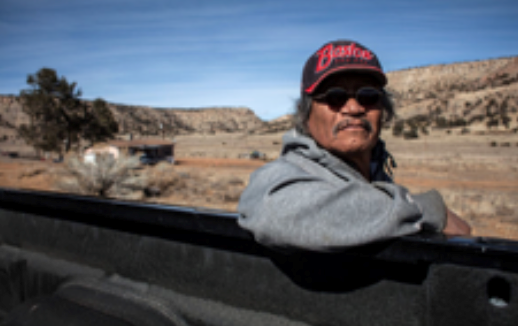
Photo: Tony Hood, uranium miner from Red Water Pond Road Community, Navajo Nation
What policies are we advocating for?
Thanks to the tireless work of impacted communities, the RECA Amendments of 2021 (H.R. 5338/S. 2798) have been introduced in the House and Senate with bipartisan support.
This bill would expand RECA and better cover those harmed by:
Extending RECA by 19 years;
Increasing payments to $150,000 for all claimants;
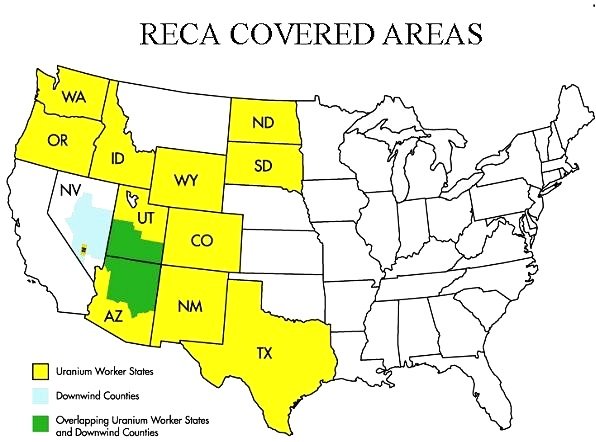
Adding downwind eligibility for all of Colorado, Idaho, Montana, New Mexico, Guam, Arizona, Nevada, and Utah, which were shown to have received high levels of fallout from nuclear testing; and
Extending the period for uranium worker eligibility and additional uranium worker categories.
Adding chronic lymphocytic leukemia as a compensable disease for downwinders and atomic veterans, and compensating additional categories of uranium workers who develop renal diseases.
What resources are currently available if I qualify for RECA?
Downwinders from certain counties in Arizona, Nevada, and Utah are eligible for $50,000.
“Onsite participants” of atmospheric nuclear weapons tests — also known as atomic veterans — are eligible for $75,000.
Uranium miners, millers, and ore transporters who worked in the uranium industry from 1942 to 1971 are eligible for $100,000, as well as additional benefits through the EEOICPA.
No-cost medical screenings for compensable illnesses at select clinics.